I released my first book 5 years ago (2021) with blissful hope and big dreams. As a debut author, I quickly learned self-publishing might’ve been as ‘easy’ as loading my manuscript into Amazon’s Kindle Direct Publishing (read: not easy at all; that alone was a learning curve), but actually selling books was another level of difficulty.
I’ve made my share of mistakes and wrong assumptions, and for the fifth anniversary of my debut’s release, I’ve decided to share five back cover mistakes I made, specifically regarding back cover copy,* and how I fixed them in 2023 with a new back cover.
*Apparently the technical name for what we call the words on the back cover is a highly debated subject…so to clarify, this blog will cover back cover copy, blurbs, endorsements, and descriptions.
But before we start, I’ll let you peek at the original back cover of my book. See if you can spot the issues for yourself first.
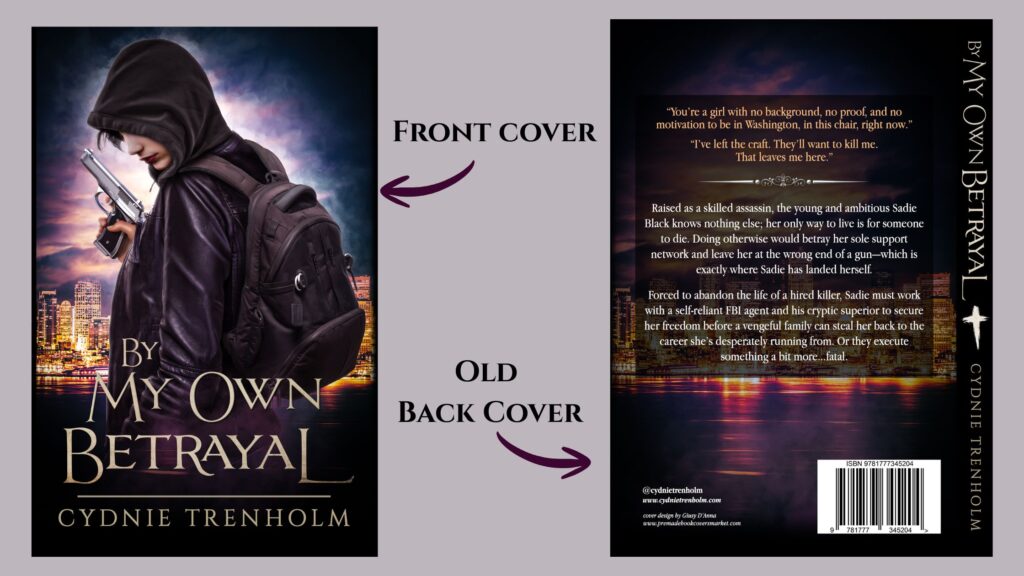
Back Cover Mistake 1: Trying to make my book appeal to everyone, not focusing on my target audience.
I wrote my book for Christian teens, but I didn’t want the faith component to scare anyone away. Secretly hoping it was “good enough” for both secular and Christian readers, I downplayed the faith element in the blurb to appeal to a ‘broader audience.’ However, reviewers of my book had OPINIONS about not being informed of this critical theme, and in many ways it felt like a “bait-and-switch.’
On the flip side, the vague blurb scared away my ideal audience. Because I didn’t give any clues that it was faith-based, many readers assumed that it was grotesquely violent and would otherwise compromise their values, rather than affirming them.
Solution: Get really specific about the kind of person who would want to read your book, and tailor your description to THEM. What do they like to read? What expectations do they have for the genre you’re writing in? How do you signal to them that this is the kind of book that they might like? If you have a list of 7 or more interests/attributes, you’ll have a clear target for your marketing. That doesn’t mean that others also won’t enjoy your book if they only have 3-4 matching attributes–they might!–but this gives you the clarity to include what is necessary in your descriptions.
I also had to get comfortable with scaring people away. Not everyone is going to like my book; even the timeless classics have haters. In my opinion, it’s better to scare away haters at the blurb than let them spend their money on your book, get halfway, and leave frustrated because the author wasn’t clear in the description. (I say this as someone who also has ordered books that I thought I’d love, only to get halfway through and realize the main plot was nothing like what was described on the back. While I’m not a ‘hater’ and I don’t leave scathing reviews, it still makes me hesitant to pick up non-recommended books).
In other words, think like a reader. What information do you look for when you pick up a book? Are you concerned with the presence of gore or explicit content? Do you prefer books with a prominent romantic plot set in ancient Greece, or would you rather read something about the brotherhood of soldiers in World War 2? You have preferences, and so do the others who also frequent your favourite bookstore.
Make it as EASY as possible for your ideal reader to decide whether or not they’d like this book.
Mistake 2: Not committing to a quick, catchy hook/tagline.
In a world of goldfish-level attention spans, you need to grab a prospective reader the MOMENT they flip the book over or click the Amazon description. This is one of the things I downplayed when my editor and I worked on my back cover copy. I had an idea for a catchy hook, but he was concerned it would be confusing because it piggybacked on a popular Scripture verse. As a newbie, I took his advice and used a quote from the book instead. Sales were slow, but I attributed that to being a new author (which is totally a fair point that I’ll address in Mistake 5), but I decided to try out my original tagline idea on Instagram to see if it made a difference. When I had readers saying that they read that line alone and were sold, I knew I’d cracked the code on something quick, memorable, and attractive to my audience (at least for this book).
Solution: Find a pithy way to pitch your book in one or two sentences. You aren’t divulging the plot in the hook; but you’re introducing your readers to the heart of it. A quote from the book might accomplish this, but it often doesn’t have the context to really give a browser the same connection that keeps them reading.
But how do you know that a hook is doing what it’s supposed to?
Mistake 3: Not market-testing descriptions and hooks.
We trust our friends. We trust our editors. We love our family, and when you’re just starting out, these are often the easiest places for getting feedback. However, these people all have something that complete strangers don’t have: context.
They know who you are. They’re invested in your success as a loved one, and that makes them biased. Even when they try not to be, sometimes that actually makes them biased in the opposite direction, criticizing the good along with the bad. They can be a great starting point, but they shouldn’t be where you stop.
Solution: Put your work out in the real world. I knew that the new tagline worked because I tried it out. While I don’t post much on social media anymore, that arena allowed me to experiment with different taglines and slogans. If you’re not on socials, try putting possible hooks in the subject line of your email newsletter to see which ones have a higher open rate. If you’re brave, I’ve heard of authors asking strangers if they’d be willing to read the blurb or hook and tell them what they think.
It’s also worth noting that there are real people (not AI bots) who have studied back cover copy and are excellent at giving you a blurb that serves your audience. This is a skill, and if you’re willing to pay for it, it can help you with this part of the process (though I recommend testing it out regardless).
Mistake 4: Giving up on social credit and buying the belief that only big authors are worth getting endorsements.
Full confession: I emailed twenty authors/public figures about getting endorsements before my debut’s release. Four of them got back to me, letting me know they were unable to do so at this time. Turns out, if you don’t have an agent, getting endorsements from the ‘big names’ is nearly impossible. When this failed, I turned to the writer blogs I was reading at the time, which said that anyone less than a ‘big’ author was a waste of time and space as far as endorsements were concerned. “If readers won’t recognize the name, it’s not worth it,” they said.
So I released the book with no endorsements and a handful of reviews from Advanced Reader Copies on Amazon and Goodreads. Readers online seemed interested, but hesitant (perhaps due to previous experiences with new books). In a split-second, they decided against it–there was no proof that someone other than the author’s close friends and family had read it, so they kept scrolling.
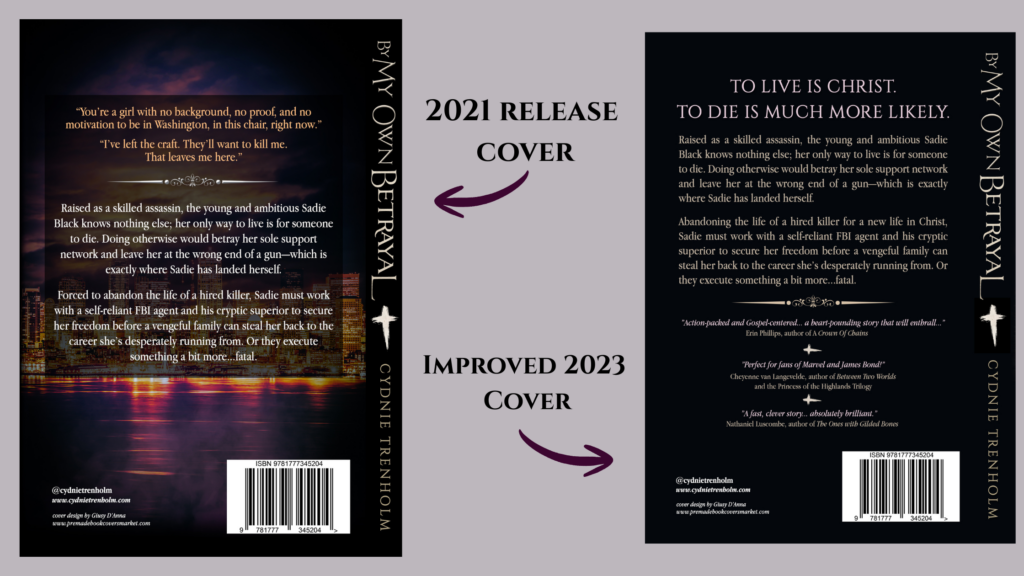
Solution: Get social proof, no matter how small. Once I decided to re-do the back cover, I asked three author friends who had already read it if they would endorse it. They all had one or two books out, making them ‘too small’ by the writing blog’s metrics to be ‘worth it,’ but their words are some of the best ones on the cover (and just inside it on the new Praise page). The endorsements immediately tell the reader that someone liked it, and having a book title beside the author’s name offered instant credentials to the claim that this was a book worth reading. My fellow authors were happy to be asked, and they also received some ‘marketing’ kickback as I advertised their book on the back of mine. Talk about a win-win situation.
At this time, I’d also started following another indie author on Instagram. At 10k followers, she had a higher follower count than any of my author friends, and I’d had several organic interactions with her. I summoned courage and decided to ask for an endorsement, offering to send her a paperback copy of the current book. It just so happened that she had extra room in her schedule that month, and she graciously agreed. Within the year, she went viral and quadrupled her follower count, and now she has over 60k followers and pays bills with her writing. I absolutely love this example because she wouldn’t have been ‘big enough’ to count when I asked her, but now she is.
As an indie author, I get to play the long-game of book sales, and you never know when one of your author friends’ books will take off.
(If you want to read their endorsements, you can read them here.)
As a quick caveat, it is important that the authors who endorse your book have at least SOME overlap with your genre, such as having books with similar themes, plot-pacing, character arcs, values, etc. Otherwise you run the risk of the ‘bait-and-switch’ problem I mentioned earlier. If they like the book, you’re probably safe, but I still wanted to note that.
Mistake 5: Wanting the cover to be “cool” rather than “clear.”
My cover artist sent back several proofs with this epic background that mimicked the front cover. We focused on the fonts and the text placement. The background was a no-brainer because it was cool. It tied into the amazingly done front cover, and I was thrilled.
However, as time went on, I realized that the background got more attention than the hook/blurb. If anything, it distracted from it, feeling cool but overwhelming to prospective readers (you can see it in a person’s face when they flip over a book and their eyes jump everywhere trying to find an anchor).
Solution: Simple is often best. Clarity trumps being clever, and that applies visually too.
If you think it might be distracting or hard to read, it will be. It’s worth going back-and-forth with your artist to get it right; in my case, I went back to her with a mock-up I made with Canva of a new format on a completely black backdrop. She ran with the concept, and now I have an easy-to-follow back cover that didn’t entirely sacrifice ‘looking cool.’
Here’s the two covers side-by-side for you to compare. If you have a copy, I’d love to hear which copy you have and what drew you to the story in the first place.
And if this cover has done what it’s supposed to and you want to peek inside, you can get the first 101 pages FREE when you sign up for my newsletter.